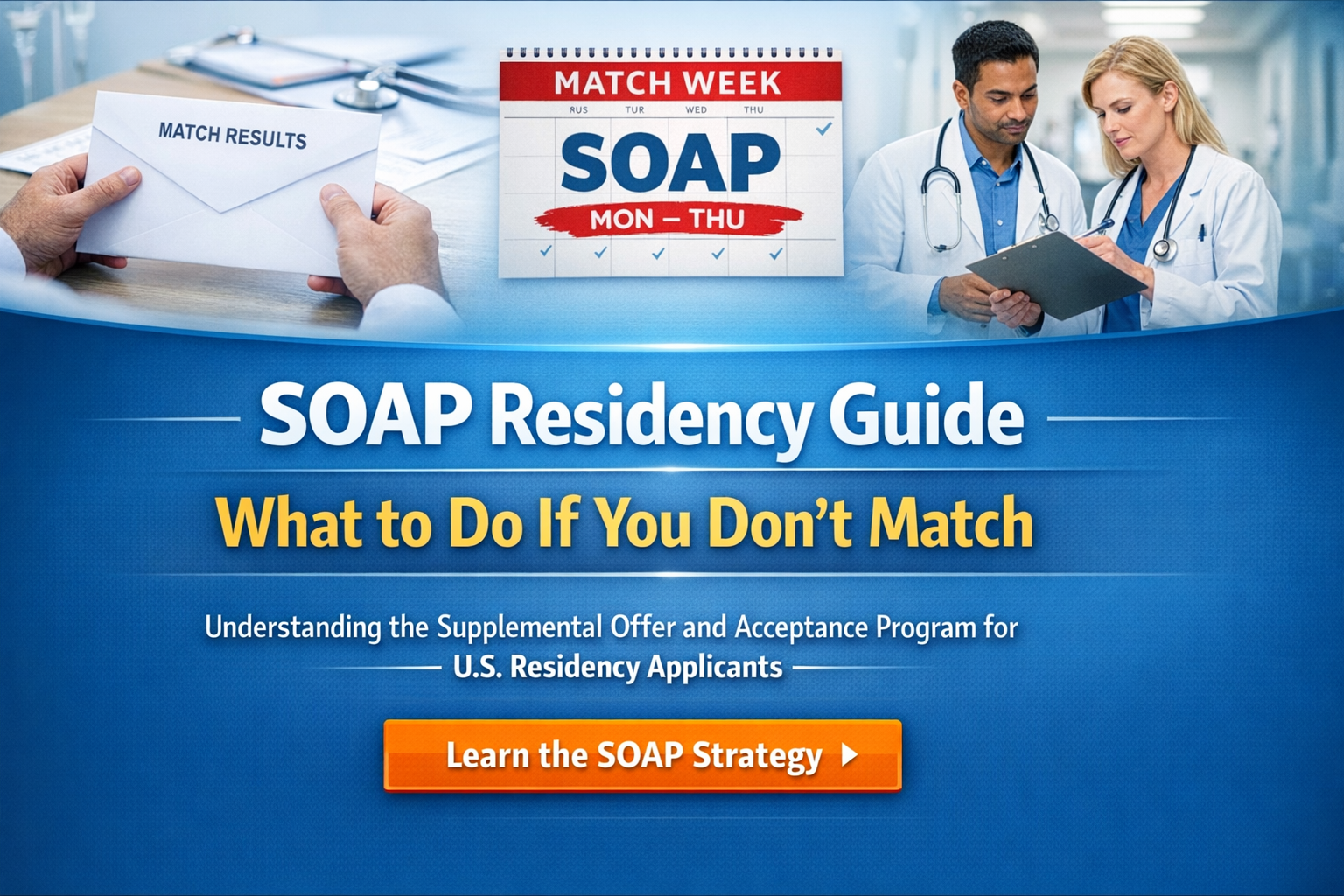
What Is SOAP in the Residency Match? A Complete Guide for Applicants

The residency Match is one of the most important milestones in a physician’s career. However, not every applicant secures a position during the initial Match process. For those who remain unmatched, the Supplemental Offer and Acceptance Program (SOAP) provides another opportunity to obtain a residency position during Match Week.

This blog explains what SOAP is, how it works, and how applicants can navigate the process successfully.

What Is SOAP?

The Supplemental Offer and Acceptance Program (SOAP) is a structured system used by the National Resident Matching Program to help unmatched or partially matched applicants secure residency positions that remain unfilled after the main Match.

In simple terms, SOAP is a second chance to match into residency programs during Match Week.

SOAP replaced the old “Scramble” system in 2012, creating a more organized and transparent process for filling open residency positions.


Who Is Eligible for SOAP?

Not every applicant can participate in SOAP. To be eligible, applicants must:

  • Be registered for the Main Residency Match

  • Be unmatched or partially matched when results are released on Monday of Match Week

  • Meet eligibility requirements set by the NRMP and the application service used by the program.

Applicants who already matched to a residency position are not eligible for SOAP.


How SOAP Works During Match Week

SOAP occurs during Match Week (Monday–Thursday) and follows a structured timeline.

1. Match Status Notification (Monday)

Applicants receive an email indicating whether they matched or did not match, but the program name is not yet revealed.

If an applicant is unmatched, they gain access to a list of programs with unfilled residency positions.

2. Apply to Unfilled Programs

Applicants can apply to programs with open positions through the residency application system.

Programs then review applications and may contact applicants for brief interviews.

3. Offer Rounds

Residency programs send offers through the NRMP system in multiple rounds.

Each round gives applicants a limited time window (usually about two hours) to accept or decline the offer.

Several rounds of offers occur until available positions are filled.


Why SOAP Matters

SOAP is an important safety net for applicants who do not match initially. It provides:

  • A structured process for filling open residency positions

  • Equal access to unfilled programs

  • A second opportunity for applicants to start residency training that year.

For many applicants, SOAP can turn a disappointing Match result into a successful residency placement.


Tips for SOAP Success

If you anticipate the possibility of entering SOAP, preparation is essential.

1. Prepare Application Materials Early
Make sure your CV, personal statement, and letters of recommendation are ready before Match Week.

2. Be Flexible With Specialties
Some specialties have more unfilled positions than others, so flexibility can increase your chances.

3. Respond Quickly to Offers
SOAP operates on tight timelines, and quick decision-making is crucial.

4. Maintain Professional Communication
Programs may conduct rapid interviews, so professionalism and clarity are key.


Final Thoughts

While matching during the main residency Match is the goal for most applicants, not matching initially does not mean the end of the journey. The Supplemental Offer and Acceptance Program offers a structured and transparent pathway for unmatched applicants to secure residency positions during Match Week.

With preparation, flexibility, and quick decision-making, SOAP can serve as an important opportunity to continue your medical training and move forward in your career.

Residency Interview Preparation: Tips to Stand Out and Match Successfully

Securing a residency position in the United States is one of the biggest milestones for any international medical graduate (IMG). The journey begins with years of preparation, passing the USMLE exams, gaining valuable clinical experience, and finally, succeeding in residency interviews. The interview stage is not just about showcasing your medical knowledge but also about demonstrating your communication skills, professionalism, and cultural adaptability.

For many IMGs, this can feel overwhelming, but with the right strategy, mentorship, and preparation, you can stand out among the competition. At IFMGE, we specialize in guiding IMGs through every step of this process helping them secure the right clinical rotations, connect with the best USMLE mentors, and ultimately match into residency successfully.

In this guide, we’ll discuss how you can prepare for residency interviews, what program directors are looking for, and how to leverage externship experiences to stand out.

Why Residency Interviews Matter

The residency interview is not just a formality, it is often the deciding factor after your application has been reviewed. Program directors use interviews to assess qualities that cannot be captured on paper:

  • Communication skills: How well do you explain complex medical concepts in simple terms?
  • Professionalism: Do you present yourself as someone who will work well in a team?
  • Adaptability: Can you adjust to the U.S. healthcare system?
  • Motivation: Why did you choose this specialty and this program?

Your performance in these areas can make the difference between a successful match and a missed opportunity.

Preparation Tips to Excel in Residency Interviews

1. Understand the Program and Specialty

Before the interview, research each program thoroughly. Know their patient population, affiliated hospitals, and unique strengths. If you’re interviewing at IMG-friendly hospitals in USA, make sure you highlight your adaptability and prior U.S. clinical experience.

2. Practice Common Interview Questions

Some of the most frequent questions include:

1. “Tell me about yourself.”

2. “Why did you choose this specialty?”

3. “What makes you a good fit for our program?”

4. “What are your strengths and weaknesses?”

Craft structured yet genuine answers. Avoid memorizing scripts program directors value authenticity.

3. Highlight Your U.S. Clinical Experience

Externships and observerships in the U.S. are highly valued. If you’ve completed rotations through IFMGE, emphasize the skills you gained such as patient communication, teamwork, and understanding electronic health records. This shows that you are already familiar with the U.S. healthcare system.

Your ability to demonstrate US externship success is often a game-changer in residency interviews. Share stories about meaningful patient interactions or teamwork moments during your rotations.

4. Showcase Mentorship and Guidance

Having mentors is a strong indicator of your commitment and support network. Many IMGs benefit from mentors for IMGs during externship programs, who guide them not only in clinical work but also in cultural adjustment and professional development.

When asked about your journey, mention how mentorship shaped your clinical reasoning or interview preparation. This demonstrates that you value learning and growth.

5. Practice Mock Interviews

Work with peers, mentors, or professional services like IFMGE to conduct mock interviews. Feedback on body language, tone, and clarity can significantly boost your confidence.

The Role of Externships in Residency Preparation

Externships are more than just clinical rotations; they are stepping stones to residency. For IMGs, they serve three critical purposes:

1. Hands-on U.S. Experience – Externships expose IMGs to real patient interactions and medical practices in the U.S.

2. Letters of Recommendation (LoRs) – Strong LoRs from U.S. physicians carry significant weight during residency selection.

3. Interview Talking Points – Your externship experiences provide real-life stories to discuss during interviews.

At IFMGE, we have seen countless students achieve US externship success and secure competitive LoRs that directly contributed to their match success. Programs are more likely to select candidates who have proven themselves in clinical settings within the U.S.

Building Strong Relationships with Mentors

Residency interviews are as much about who you know as what you know. Strong mentorship can provide insights that no textbook can.

-> Best USMLE mentors help you prepare strategically for the exams and give you confidence heading into interviews.

-> Mentors for IMGs during externship programs offer guidance on cultural expectations, professionalism, and communication.

-> Alumni mentors from IMG-friendly hospitals in USA can share their personal experiences on how they succeeded in interviews.

Mentioning the influence of your mentors during interviews shows humility and gratitude qualities program directors deeply appreciate.

Making a Lasting Impression

Here are a few additional strategies to leave a positive impression:

1. Dress professionally: Conservative and polished attire shows respect for the process.

2. Be punctual: Arriving late (or logging in late for virtual interviews) is an immediate red flag.

3. Show enthusiasm: Program directors want residents who are genuinely excited to join their team.

4. Ask thoughtful questions: Always prepare 2–3 insightful questions about the program. Avoid asking things you could easily find on their website.

The IFMGE Advantage

At IFMGE, we believe that IMGs can thrive in the U.S. medical system with the right preparation and mentorship. Our services are designed to:

-> Provide access to IMG-friendly hospitals in USA for externship and observership programs.

-> Connect students with the best USMLE mentors who guide them through exam preparation and interview strategies.

-> Pair IMGs with experienced physicians who serve as mentors during externship programs.

-> Offer personalized coaching for residency interview preparation.

Our track record of guiding IMGs toward US externship success has led to many of our students successfully matching into residency programs across the country.

Final Thoughts

Residency interview preparation requires more than just rehearsing answers; it is about demonstrating your readiness to become part of the U.S. healthcare system. By leveraging your externship experiences, highlighting mentorship, and practicing diligently, you can stand out as a competitive candidate.

The support of organizations like IFMGE, IMGs can access valuable externship opportunities, receive mentorship from leading physicians, and prepare confidently for residency interviews. Remember, your interview is your chance to show not just your medical knowledge, but also your character, adaptability, and passion for medicine.

If you put in the effort, build strong relationships, and focus on demonstrating your growth during externships, you will increase your chances of matching successfully.

How to Avoid Errors in Your Residency Application

Applying to residency programs in the U.S. can be both exciting and overwhelming especially for International Medical Graduates (IMGs). The path to a successful Match often depends on more than just exam scores and clinical exposure; it also hinges on avoiding common residency application mistakes that can cost even the strongest candidates interview offers.

At IFMGE, we’ve helped thousands of IMGs navigate the complexities of the Match process. From securing US clinical experience for IMGs, to offering personalized clinical rotation guidance for IMGs, to proofreading ERAS submissions our mission is to ensure your application is flawless and competitive.

In this guide, we’ll break down how to avoid costly ERAS application mistakes, offer insights into observerships in the US, and share tips on presenting yourself as the ideal residency candidate.

1. Understand the Importance of a Strong Application

The ERAS (Electronic Residency Application Service) platform is where your residency journey begins. A well-prepared application tells your story clearly, demonstrates your clinical competence, and shows you’re ready for residency in the U.S. Unfortunately, many IMGs lose opportunities due to avoidable ERAS application mistakes.

At IFMGE, we review hundreds of applications every year and repeatedly see the same issues: incomplete sections, vague personal statements, incorrect formatting, or failure to showcase relevant US clinical experience for IMGs. 

2. Top Common Residency Application Mistakes to Avoid

Here are the most frequent and damaging common residency application mistakes that IMGs make:

a. Incomplete or Incorrect ERAS Entries

Missing information, inconsistent dates, or formatting errors in your CV section can cause program directors to question your attention to detail.

Fix it: Double-check every field. Use consistent formatting, and include all relevant experiences especially your observerships in the US and other US clinical experience for IMGs.

b. Weak Personal Statements

Generic or poorly written personal statements are one of the most overlooked ERAS application mistakes. Avoid clichés like “I’ve always wanted to help people,” and instead focus on your unique path as an IMG.

Fix it: Highlight specific experiences during observerships in the US or rotations, especially moments that reflect your passion and readiness.

c. Unfocused Letters of Recommendation

Using outdated or irrelevant LORs can weaken your application. Choose referees who observed your performance directly preferably during US clinical experience for IMGs.

Fix it: Request letters during or immediately after rotations, and ensure they’re uploaded properly into ERAS.

d. Failing to Tailor Applications

Applying broadly is good, but submitting the same generic application to every program is a major ERAS application mistake.

Fix it: Customize personal statements and prioritize programs where your background aligns. Use clinical rotation guidance for IMGs (like from IFMGE) to find the right-fit programs.

3. The Role of Clinical Experience in a Strong Application

Your application is only as strong as your experience. US clinical experience for IMGs is often a deciding factor in interview selection.

Why U.S. Experience Matters:

-> It proves your adaptability to the U.S. healthcare system.

-> Provides opportunities to earn U.S.-based letters of recommendation.

-> Demonstrates hands-on clinical exposure and communication skills.

Observerships and Rotations

Many IMGs gain this experience through observerships in the US or structured externship programs. While observerships in the US are not hands-on, they still offer invaluable exposure, learning, and networking.

At IFMGE, we offer access to both observerships in the US and hands-on externships. Our advisors also provide expert clinical rotation guidance for IMGs to help you choose the most relevant specialties and settings for your goals.

4. Clinical Rotation Guidance for IMGs: Choosing Wisely

A key step in application preparation is choosing the right clinical settings. Not all rotations are equal, and wasting time in irrelevant or unrecognized programs is a major misstep.

Common Missteps in Rotations:

-> Choosing non-teaching hospitals without faculty who can write LORs.

-> Rotating in specialties unrelated to your desired field.

-> Starting late and rushing to complete rotations close to deadlines.

Fix it: Seek expert clinical rotation guidance for IMGs to select hospitals with a proven track record of working with IMGs and offering LORs. At IFMGE, we connect you to preceptors who are familiar with ERAS expectations and who can support your success.

5. Timing Is Everything

One of the easiest common residency application mistakes to avoid is poor timing. Many IMGs submit applications late or don’t leave enough time for documents like MSPEs and LORs to be uploaded.

Key Deadlines:

  • ERAS opens (Mid-June): Start preparing documents early.
  • Applications accepted by programs (Mid-September): Submit by the opening date to be in the first wave.
  • NRMP Match registration (September–November): Complete registration and rank list on time.

Fix it: Build a timeline. At IFMGE, we help students plan every detail from securing observerships in the US to uploading their final documents well before deadlines.

6. Highlighting Your Strengths as an IMG

Many IMGs focus too much on what they lack, rather than on what they bring to the table. Program directors value applicants who:

-> Show resilience and adaptability.

-> Have meaningful US clinical experience for IMGs.

-> Communicate well and show cultural competency.

Use your observerships in the US and international background to showcase these traits. Reference specific cases or patient encounters that shaped your understanding of U.S. healthcare. These stories can make a huge difference when applying.

7. Final Review: Your Application Checklist

Before hitting “Submit,” walk through this checklist:

✅ Personal statement tailored to specialty and program
✅ U.S.-based LORs from relevant rotations
✅ ERAS CV sections completed with consistent formatting
✅ US clinical experience for IMGs properly listed
✅ Experience from observerships in the US clearly described
✅ No typos, grammar errors, or date inconsistencies
✅ Applications submitted early
✅ Guidance received from trusted sources (like IFMGE)

8. IFMGE: Helping You Get It Right

At IFMGE, we understand the stakes. One small oversight can lead to missed interviews. That’s why we offer comprehensive support:

-> ERAS document review to eliminate ERAS application mistakes

-> Clinical rotation guidance for IMGs tailored to your target specialties

-> Access to vetted observerships in the US and externship placements

-> Personalized mentoring to optimize your application strategy

We believe every IMG deserves a fair chance to succeed and that starts with a flawless application.

Conclusion

Avoiding common residency application mistakes isn’t just about avoiding typos or formatting issues, it’s about presenting yourself with clarity, confidence, and purpose. From securing US clinical experience for IMGs, to getting expert clinical rotation guidance for IMGs, to wisely listing your observerships in the US, every choice you make tells a story.

Getting Great Letters of Recommendation for Residency

They provide residency program directors with insight into your clinical skills, professionalism, communication, and overall potential as a resident physician. For International Medical Graduates (IMGs), getting the best LORs for residency requires planning, effort, and strategic networking especially during U.S. clinical experiences.

At IFMGE, we understand the challenges that IMGs face in securing strong letters. From identifying mentors for IMGs during externship programs, to planning your USMLE study plan while in observership, and targeting US hospitals accepting IMGs for rotations, we’re here to support you through every step of your journey.

Why Letters of Recommendation Matter

Your LORs speak directly to your clinical acumen, work ethic, and personality. A well-written, personalized recommendation can be the deciding factor in whether a residency program invites you for an interview. This is particularly true for IMGs, who must work harder to prove their readiness for the U.S. healthcare system.

That’s why aiming for the best LORs for residency should be at the top of your priority list during any U.S. rotation, externship, or observership.

Types of Letters in ERAS

In the ERAS letters of recommendation system, applicants can upload up to four LORs per program, though most programs require only three. LORs can be:

-> Specialty-specific: From a physician in the specialty you’re applying to (e.g., internal medicine, pediatrics).

-> General clinical: From U.S.-based doctors who supervised you in rotations or externships.

-> Chairman’s letter: Sometimes required for competitive specialties.

For the strongest ERAS letters of recommendation, focus on quality over quantity. It’s better to have three personalized and specific letters than four generic ones.

Choosing the Right Clinical Experience for LORs

The foundation of a strong LOR is a meaningful clinical relationship. To build that relationship, you need to be in the right environment, one where your efforts and skills can be noticed.

1. US Hospitals Accepting IMGs for Rotations

Finding US hospitals accepting IMGs for rotations is the first step. These hospitals are familiar with IMG applicants and are more likely to offer opportunities where you can shine. Popular options include hospitals in New York, Florida, Texas, and California.

Through our support at IFMGE, we connect students with US hospitals accepting IMGs for rotations where preceptors are not only IMG-friendly but also experienced in writing LORs for residency candidates.

During these rotations, be proactive. Ask questions, show initiative, and document cases. The more involved you are, the more your preceptors will remember your contributions leading to some of the best LORs for residency.

2. Externships vs. Observerships: A Strategic Decision

If you’re deciding between an observership or externship, keep in mind that externships allow for hands-on involvement, which leads to stronger LORs. Observerships are valuable too, but you must work harder to stand out.

Building rapport with mentors for IMGs during externship programs is often easier, as these mentors can directly assess your clinical performance.

Mentorship: A Key to Strong Letters

One of the most overlooked elements of a great LOR is mentorship. Mentors for IMGs during externship programs are often physicians who have worked with international medical students for years. They understand what program directors look for and can tailor your LORs accordingly.

Here’s how to cultivate mentorship:

-> Be dependable: Arrive early, follow up on cases, and show genuine enthusiasm.

-> Ask for feedback: This not only shows commitment but also creates talking points for your LOR.

-> Stay in touch: A follow-up email or thank-you note post-rotation goes a long way.

At IFMGE, we help connect students with seasoned mentors for IMGs during externship programs, ensuring they’re not just observers but active learners with future recommendation letters in mind.

Studying for the USMLE While Earning LORs

It can be challenging to juggle clinical rotations and exam prep. But crafting a realistic USMLE study plan while in observership is essential. Why? Because demonstrating your knowledge during an observership, even in non-clinical interactions, can impress your mentors and result in stronger LORs.

Here’s how to make it work:

-> Morning routine: Dedicate an hour to USMLE prep before your observership starts.

-> Clinical reinforcement: Use real-life cases to reinforce your understanding of exam concepts.

-> Weekend reviews: Deep-dive into question banks when off duty.

By balancing rotations and your USMLE study plan while in observership, you show your commitment to excellence something letter writers will be happy to include.

Timing Your Requests Strategically

The best time to ask for a letter? Toward the end of your rotation, when your contributions are fresh in your mentor’s mind. Don’t wait too long. In fact, it’s helpful to bring up the topic earlier, so the physician knows to observe you with that in mind.

Tips for asking:

-> Be direct but respectful: “Dr. Smith, I’ve really valued learning from you. Would you be willing to write me a strong letter of recommendation for my ERAS application?”

-> Provide details: Give them your CV, personal statement, and even a bullet list of what you learned or contributed.

-> Use ERAS tools: The ERAS letters of recommendation portal makes it easy for writers to upload letters directly and confidentially.

What Makes the Best LORs for Residency?

Whether it’s written by a specialist or generalist, the best LORs for residency are:

-> Personalized: They speak to your individual strengths, not generic praise.

-> Descriptive: Include specific examples of your clinical performance.

-> Specialty-specific: Written by someone in the specialty you’re applying for.

-> Written in U.S. settings: U.S.-based LORs carry significantly more weight in the Match process.

We’ve helped countless students at IFMGE secure such letters by aligning them with the right US hospitals accepting IMGs for rotations, prepping them for clinical success, and matching them with top mentors for IMGs during externship programs.

Conclusion

Getting the best LORs for residency is not just about asking the right person, it’s about being the right candidate. That requires preparation, performance, and planning. From identifying US hospitals accepting IMGs for rotations, to working under experienced mentors for IMGs during externship programs, and maintaining your USMLE study plan while in observership, each step matters.

If you’re serious about securing impactful ERAS letters of recommendation, reach out to IFMGE today. We specialize in helping IMGs build the credentials and connections needed for a successful Match.

Key ERAS & NRMP Dates Every IMG Should Know

As an International Medical Graduate (IMG), navigating the complexities of the ERAS timeline for IMGs and mastering NRMP registration for IMGs are critical steps toward securing a residency spot in the United States. Fortunately, at IFMGE, we’re dedicated to providing you with clear, actionable guidance whether you’re balancing studying for Step exams with attending observerships, comparing externship vs observership for IMGs, or pinpointing IMG-friendly hospitals in USA.

1. Overview of ERAS & NRMP for IMGs

1. ERAS (Electronic Residency Application Service) opens up your application journey. Knowing key ERAS dates and deadlines is paramount this is the ERAS timeline for IMGs in action.

2. NRMP (National Resident Matching Program) is where your dream of matching into a U.S. residency starts to become a reality. Staying on top of NRMP registration for IMGs ensures you’re in the game when match day arrives.

2. ERAS Timeline for IMGs: What to Know

Below is a typical ERAS cycle outline though these dates can shift check current official sources annually.

1. Mid‑June (e.g., June 15): ERAS residency application opening. This marks the start of uploading your application documents.

2. Early July: Medical school and Dean’s office begin sending MSPEs, transcripts, letters of recommendation.

3. Late August to Early September (approx. August 20–September 5): Programs can begin reviewing applications. This is when the ERAS timeline for IMGs in earnest begins.

4. September to October: Interview season kicks off. If you’re balancing a clinical observership for IMGs or an externship, this period demands tactful juggling of time.

5. Late September–November: Interviews conducted. Applicants should stay responsive and prepped.

6. Late November to early December: The Rank Order List submission window. Being sure your NRMP registration for IMGs is complete before this point is crucial.

7. Mid‑March (usually March 15 or 16): Match Day! The final day to celebrate accomplishment.


3. NRMP Registration for IMGs: Don’t Miss It

Mark these dates for the NRMP registration for IMGs:

1. Early September: NRMP registration opens. Ensure that you’ve registered and paid fees within this window to participate in the match.

2. Late September (often 6–8 days after registration opens): Create and finalize your Rank Order List.

3. Late November: Rank List certification deadline. If missing, you could be ineligible for the match.

4. Mid‑March: Match Day, culminating your application cycle.

Aligning your NRMP registration for IMGs with the ERAS timeline for IMGs ensures you’re both eligible and ready when programs start offering interviews and extending invitations.

4. Externship vs Observership for IMGs

If you’re planning to strengthen your application by adding clinical experience, you’ll want to fully understand the difference between externship vs observership for IMGs:

1. Observerships are non‑hands‑on experiences where you shadow U.S. physicians. Great for networking, gaining U.S. clinical exposure, and enhancing your CV but no formal access to patient care.

2. Externships, by contrast, are hands-on clinical roles usually limited to medical students enrolled in U.S. or accredited international programs. Not all IMGs are eligible.

At IFMGE, we often advise applicants to strategically integrate either an externship vs observership for IMGs based on availability, eligibility, and timing within the ERAS timeline for IMGs. For many, an observership is more realistic and valuable than none, particularly during interview season.

5. USMLE Study Plan While in Observership

Keeping up momentum with your USMLE study plan while in observership is crucial. Time flies during clinical rotations:

1. Plan ahead: Pre‑map your study schedule around observership hours. Use evenings and weekends smartly.

2. Focus on high‑yield resources: Especially for Steps 2 CK and Step 3, integrate question banks and practice tests around clinical learnings.

3. Consistency over intensity: Even 1–2 focused hours per day can make a big difference; keep your USMLE study plan while in observership active.

4. Use observership wisely: Observe U.S. clinical reasoning and terminology this indirectly reinforces USMLE-style thinking.

At IFMGE, we support building a realistic USMLE study plan while in observership, one that balances learning, clinical exposure, and residency application milestones.

6. IMG-Friendly Hospitals in USA

Identifying IMG-friendly hospitals in USA can shape both your clinical experience and your application strategy:

1. Some teaching hospitals are known to consider IMGs more favorably for example, BronxCare Health System, Detroit Medical Center, and Strong Memorial Hospital in Rochester.

2. Connecting with an observership or externship at IMG-friendly hospitals in USA can provide U.S. clinical exposure and identifiable recommenders.

Conclusion

Incorporating IMG-friendly hospitals in USA into your USMLE study plan while in observership or application strategy can enhance authenticity, credibility, and confidence. Talk to IFMGE to learn which institutions are the most welcoming to IMGs in your desired specialty.

Residency Interview Prep for International Medical Graduates

While passing the USMLE exams is a crucial step, successfully navigating the residency interview process can make or break your chances of matching. The interview gives program directors insight into who you are beyond your CV and test scores. It’s your opportunity to demonstrate your communication skills, professionalism, and cultural readiness for the U.S. healthcare system.

At IFMGE, we specialize in helping IMGs prepare for every phase of the residency journey, especially the high-stakes interview season. In this blog, we’ll explore essential USMLE residency interview tips, how your US clinical experience as an IMG plays a role, and how clinical rotation guidance can strengthen your confidence before facing U.S. program directors.

Why Residency Interviews Matter So Much for IMGs

Residency interviews aren’t just about confirming academic merit. For IMGs, interviews are often the only direct interaction a program has with the applicant. You’re not only competing with U.S. graduates, you must also overcome biases, showcase your adaptability, and explain your journey to becoming a physician in the U.S.

According to recent NRMP data, IMGs who ranked more programs and performed well in interviews had a significantly higher chance of matching. This means your performance in the interview room is a vital opportunity to differentiate yourself.

Top USMLE Residency Interview Tips

As part of IFMGE’s mentorship and training approach, we emphasize the following USMLE residency interview tips to our students:

1. Know Your Application Inside Out

Program directors will ask about everything on your ERAS application from your personal statement to your clinical rotations. Be ready to discuss your medical school training, specific patient encounters, and any research or volunteer work.

2. Practice Behavioral Interview Questions

Questions like “Tell me about a time you handled conflict,” or “How do you work under pressure?” are common. Prepare structured responses using the STAR method (Situation, Task, Action, Result). IFMGE provides mock interviews to help you master this skill.

3. Communicate with Clarity and Confidence

Accents are never a problem if you speak clearly and stay on topic. U.S. programs value clear communication since it reflects your ability to interact with patients and colleagues.

4. Express Your Commitment to the U.S. Healthcare System

Program directors want to see long-term commitment. Be prepared to talk about how your experiences including US clinical experience as an IMG shaped your interest in practicing in the U.S.

5. Ask Smart, Specific Questions

Asking thoughtful questions shows your interest in the program. Questions could include inquiries about mentorship, hands-on procedures, or how international medical graduates are supported in the program.

US Clinical Experience for IMGs: Your Secret Weapon

One of the most critical factors program directors consider when interviewing IMGs is U.S. clinical experience (USCE). This includes observerships, externships, clerkships, or research within the U.S. healthcare system.

IFMGE connects IMGs with US hospitals accepting IMGs for rotations, giving students the opportunity to gain first-hand experience in patient care settings. Not only does this help you understand medical culture in the U.S., but it also provides valuable letters of recommendation (LoRs), which are essential during interviews.

Why USCE Matters in Interviews:

-> It shows you’ve adapted to the U.S. style of documentation, patient communication, and teamwork.

-> It gives you relatable stories and examples to draw on when answering interview questions.

-> It builds credibility and reassures interviewers that you are ready for hands-on residency work.

Through IFMGE’s partnerships and clinical rotation guidance for IMGs, students are better prepared not just for their resumes, but also for real-world medical interactions which they can confidently talk about in interviews.

Clinical Rotation Guidance for IMGs: How IFMGE Helps

Choosing the right rotation site, specialty, and timing is critical. At IFMGE, we offer tailored clinical rotation guidance for IMGs, ensuring that every rotation adds strategic value to your application and interview readiness.

Key Aspects of Our Guidance Include:

-> Matching IMGs with US hospitals accepting IMGs for rotations in high-yield specialties like Internal Medicine, Family Medicine, and Pediatrics.

-> Structuring rotations that allow for hands-on involvement (when eligible) rather than passive observation.

-> Coaching on how to interact with supervising physicians and request meaningful LoRs.

-> Helping students document and reflect on their clinical experiences for discussion in interviews.

Mock Interviews & Personalized Coaching with IFMGE

Even the most qualified IMG can struggle in interviews without preparation. That’s why IFMGE offers personalized mock interviews with experienced mentors. These sessions simulate real interview conditions and provide feedback on everything from your body language to your answers.

Each session focuses on:

-> Common IMG interview challenges

-> USMLE-specific knowledge application

-> Articulating the value of your US clinical experience as an IMG

-> Enhancing your storytelling based on clinical encounters

We also cover virtual interview strategies essential in the post-COVID era to help you set up a professional environment, manage time zones, and maintain strong engagement through a screen.

Know the Programs Before You Interview

Research the programs thoroughly before each interview. Familiarize yourself with their patient population, faculty interests, and mission statement. Programs will often ask: “Why our program?” Your answer should go beyond generalities and reflect genuine interest and fit.

This is another area where IFMGE supports IMGs, offering program-specific coaching to help tailor your answers to individual interviews.

Final Thoughts: 

Residency interviews can be intimidating, especially for IMGs navigating a new system. But with preparation, mentorship, and the right clinical foundation, you can shine during interview season.

At IFMGE, we’re committed to helping international medical graduates transform potential into success. Our focus on USMLE residency interview tips, clinical rotation guidance for IMGs, and connections with US hospitals accepting IMGs for rotations ensures that you’re not just ready for the interview, you’re ready for your future.

Common Mistakes in CV’s for Residency Applicants

Be prepared! You will likely need to keep both digital and print copies of your CV on hand. For printing, use white or cream 24-lb paper. Use a laser printer for the best resolution. When sending digital copies, use a PDF. Double check the formatting is correct in PDF form.


Have specific resumes. A CV is asked for in many situations. It is smart to have specialty specific CVs as well as a CV specific for each experience you will apply to. 


Utilize detailed titles. It is a common mistake to send the wrong CV because it isn’t labeled well. We recommend keeping detailed document titles of what each CV is for, in addition to a date.


Use an active voice. Be sure that you are the active role in your descriptions, do not just describe what you saw others do.


Don’t share too much personal information. You don’t need to include your age, sexuality, religion, political affiliation, citizenship status, national origin, social media handle, or high-risk information like your SSN. If something personal is important to you to share, it may be better in your Personal Statement. 


Avoid errors or exaggerations. Remember that honesty and integrity always matter. You do not want to be in the position of having to explain or defend misinformation.


Incorporate it with your Personal Statement. Be aware of what might need more contextualizing and keep it in mind for your residency personal statement and interviews. For example, time off from school, or if you have a notable gap in work experience can be considered red flags. Start thinking about how you can frame an explanation for those clearly and positively in your personal statement.


Don’t waste space. Craft your descriptions sparingly, do not use terms like “responsible for” or “tasked with.” Just say what you did. Try to use accomplishment-oriented language when possible. Use examples of awards or achievements.

Call Us Or Fill Out Form